
Your cart is currently empty.

Counterfeit Bill Detectors
Not sure which one is for you? use our Product Finder
Product Finder
What are you Shopping For?
Select Your Criteria and find the right product for you

Cash Counter

Coin Counter

Counterfeit Detector

Sterilizer Machine


Contents
- Counterfeit Bill Detectors for Business Currency Authentication
- Types of Counterfeit Bill Detectors
- How Counterfeit Bill Detection Technologies Work
- Automatic vs Manual Counterfeit Bill Detectors
- Counterfeit Detector Pens vs Electronic Bill Detectors
- Key Features to Compare Before Choosing a Detector
- Which Counterfeit Bill Detector Fits Your Business?
- Counterfeit Bill Detector vs Bill Counter With Detection
- FAQ
Counterfeit Bill Detectors for Business Currency Authentication
Handling cash at scale introduces a single point of risk: accepting a fake banknote that slips past a quick visual check. Modern devices are built to remove that uncertainty. Instead of relying on human judgment, they validate multiple embedded security features in real time and return a clear decision.
In practice, this means a cashier or teller doesn’t need to interpret subtle details like print texture or micro-patterns. The device reads those signals instantly and flags inconsistencies that would otherwise go unnoticed, especially during high-traffic periods where speed matters more than scrutiny.
Types of Counterfeit Bill Detectors
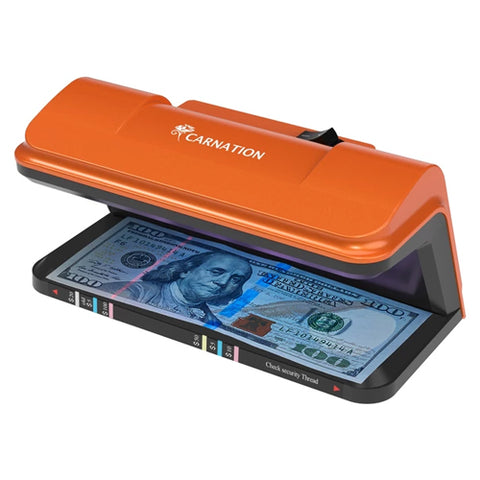
UV counterfeit bill detectors
These models reveal hidden ultraviolet elements embedded in legitimate currency. When exposed to UV light, specific threads or markings appear with precise color and placement. If those markers are missing or incorrect, the bill is immediately suspect.
Magnetic ink detection
Certain denominations contain magnetic properties in their printed ink. Devices equipped with magnetic sensors verify whether those signals exist and match expected patterns. This method is particularly effective because it’s difficult to replicate with standard printing.
Infrared detection
Infrared scanning checks how a banknote reacts to IR light. Authentic currency absorbs and reflects infrared in very specific ways, creating a distinct pattern. Counterfeit bills often fail this test even if they look convincing under normal lighting.
Automatic vs manual devices
Some tools require the user to position the bill and visually confirm results, while others pull the bill through and deliver an instant pass/fail outcome. The difference becomes critical in high-throughput environments, where decisions must be immediate.
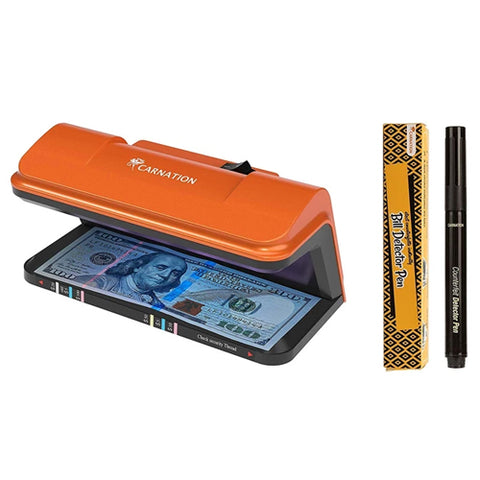
Detector pens
These are the simplest options. They test the paper composition rather than the embedded security features. While useful as a quick check, they cannot validate more advanced protections built into modern currency.
How Counterfeit Bill Detection Technologies Work
A single validation method is rarely enough. Advanced devices layer multiple checks: UV, magnetic, infrared, and dimensional analysis into one process. When a bill is inserted, sensors scan for expected responses across each detection channel.
If even one signal deviates, the system triggers an alert.
More sophisticated models go further. They analyze the size and image structure of the bill, comparing it against stored templates for each denomination. This combination of physical measurement and spectral analysis significantly reduces false positives and improves reliability across different currencies.
In high-end systems, these checks happen simultaneously, not sequentially. The result is near-instant verification without sacrificing depth.
Automatic vs Manual Counterfeit Bill Detectors
Manual inspection tools rely on the operator. They highlight certain features, but the final judgment still depends on experience. This works in controlled environments with trained staff, but consistency becomes an issue over time.
Automatic systems remove that variability. A bill is inserted, analyzed internally, and the outcome is displayed clearly, often accompanied by a visual or audio signal. There’s no interpretation required.
That distinction matters more than it seems. In a busy retail setting, even a small delay or hesitation can create friction at the point of sale. Automated validation keeps the process moving while maintaining accuracy.
Counterfeit Detector Pens vs Electronic Bill Detectors
Pens test a single variable: the chemical composition of the paper. If the paper reacts incorrectly, the mark changes color. It’s fast, inexpensive, and easy to use.
But modern counterfeit techniques rarely rely on basic paper substitutes anymore.
Electronic systems evaluate multiple dimensions of authenticity. They don’t just check what the bill is made of they verify how it behaves under different detection methods. That layered approach is what makes them viable for professional use.
Pens still have a place, but primarily as a supplementary tool rather than a primary defense.
Key Features to Compare Before Choosing a Detector
Not all devices are built for the same conditions. Some are optimized for speed, others for portability, and others for multi-currency environments.
Detection coverage is the first variable to consider. A unit that combines ultraviolet, magnetic, and infrared scanning offers broader protection than one relying on a single method.
Speed becomes critical when transaction volume increases. Automatic feeding with multi-orientation capability allows bills to be inserted in any direction without slowing down the workflow.
Alert systems also vary. Some provide simple visual indicators, while others include audible signals that reduce the need to constantly monitor the device.
For mobile or space-constrained setups, battery-powered options and compact designs can be more practical than full desktop units.
Which Counterfeit Bill Detector Fits Your Business?
A small retail counter has very different requirements compared to a bank or casino.
For low-volume environments, a compact unit with basic multi-spectrum detection may be sufficient. The goal is quick validation without adding complexity.
In financial institutions or high-cash operations, reliability under constant use becomes the priority. Devices in these settings need to process large volumes without degradation in accuracy.
Restaurants and service businesses often fall somewhere in between. They benefit from automated validation, but also need flexibility, especially when staff turnover affects training consistency.
The right choice depends less on the device itself and more on how cash moves through the business.
Counterfeit Bill Detector vs Bill Counter With Detection
A standalone unit focuses entirely on authentication. It verifies one bill at a time, ensuring accuracy before the bill enters circulation within the business.
A counting machine with integrated detection combines verification with batch processing. It scans each bill as it counts, making it more efficient at handling large stacks.
The distinction is operational. If the priority is validation at the point of transaction, a dedicated device is sufficient. If the workflow includes bulk cash handling, integrated systems reduce the need for separate steps.
FAQ
How accurate are counterfeit bill detectors?
Counterfeit bill detector accuracy depends on the detection methods used. Models that combine UV, magnetic ink, infrared, and imaging-based checks can provide stronger validation than single-method tools because they inspect more security features on each bill.
Can these counterfeit bill detectors check all currencies?
Carnation counterfeit bill detectors are designed for supported currencies, not every currency worldwide. The CRD12A supports US dollars, Euros, and Mexican pesos, while other models can check multiple currencies based on the security features they read. Always choose a detector that matches the bills your business handles most often.
What is the difference between UV, MG, and IR detection?
UV detection checks ultraviolet security marks. MG detection checks the magnetic ink used in official banknote printing. IR detection checks infrared-readable features that appear on supported currencies. A detector with multiple methods provides a more thorough check than a basic UV-only fake-money detector.
Do counterfeit bill detectors need maintenance?
Yes, but maintenance is minimal. Keep the sensors and bill path clean so dust, ink residue, and paper debris do not affect detection accuracy. This is especially important for businesses that check bills daily.
Are counterfeit bill detectors better than manual checking?
Yes, for fast retail and office environments. A detector gives consistent checks without relying on visual judgment alone. Manual checking can still help, but a counterfeit bill detector reduces the risk of human error when staff need to verify bills quickly.
Can counterfeiters bypass basic detection methods?
Counterfeit methods change over time, which is why multi-method detection is safer than relying on one check. A detector that uses UV, magnetic, infrared, and imaging-based validation is better suited for spotting suspicious bills than a single-method tool.
Which Carnation counterfeit bill detector should I choose?
Choose CRD12 if you need a simple UV fake bill checker. Choose CRD12+ if you want UV and magnetic detection in a compact device. Choose CRD12A if your business needs a stronger automatic counterfeit bill detector with UV, MG, IR, and banknote recognition features.
Translation missing: en.general.search.loading